

008615063091883
 English
-
 English
 -
عربي
-
Deutsch
-
Русский язык
-
Français
-
Latina
-
Português
-
Español


info@kingstar-glass.com
Why Tempered Glass Is Crucial for Modern Commercial Facades and Storefronts
Author:Qingdao Kingstar Glass Co., Ltd
Click:
Time:2026-09-24 21:57:21
This article is part of our ongoing series accompanying the Complete B2B Guide to Architectural Tempered Glass: Safety, Standards, and Sourcing . If you're new to sourcing tempered glass, the main guide covers the fundamentals of manufacturing, standards, and procurement. This piece focuses on why tempered glass has become the default choice for commercial facades and storefronts—and what that means for your next project.
We've shipped tempered glass to facade contractors on five continents. And if there's one thing we've learned, it's this: the commercial facade market is unforgiving. A glass panel that passes inspection in the factory can fail spectacularly on a 200-meter tower in a typhoon zone. A storefront that looks perfect on day one can shatter six months later because someone forgot that glass within 18 inches of the floor needs to be safety glazing.
The global glass facade market was valued at $176.84 billion in 2025 and is projected to reach $186.21 billion in 2026, growing at a CAGR of 5.3%. The glass curtain wall segment alone is growing even faster—from $65.47 billion in 2025 to $71.25 billion in 2026 at 8.8% CAGR. And tempered glass holds over 40% of the structural glazing market share, making it the single most specified glass type for high-rise facades and modern architectural designs.
That's not a coincidence. It's physics, economics, and building codes all pointing in the same direction.
The Wind Load Problem: Why Annealed Glass Doesn't Stand a Chance
Here's the thing about facades: they're the part of the building that takes the brunt of the weather. And wind pressure on a high-rise facade isn't a gentle breeze. It's a structural load.
According to European wind load standards (BS EN 1991-1-4), the design wind pressure on a building facade depends on the building height, terrain category, and local wind climate. For a 100-meter building in a town terrain at 10 km from the coastline, the basic velocity pressure is calculated at 750 N/m² (0.75 kPa) for a 10-minute mean wind, but the peak gust pressure—the one that actually matters for glass design—reaches 3,000 N/m² (3 kPa) based on a one-second gust duration.
And that's just the baseline. Curtain wall systems in coastal or typhoon-prone regions are typically engineered to withstand 4.5 kPa to 7.0 kPa wind loads. Some high-wind systems tested to ASTM E330 reach pressure resistance of 5.0 kPa or more.
Now compare that to glass strength. The characteristic strength of annealed glass is approximately 45 MPa. Fully tempered glass reaches 120 MPa—roughly 4 to 5 times stronger. Heat-strengthened glass sits in between at around 70 MPa.
When a facade panel is subjected to uniform wind pressure, the glass experiences bending stress. The maximum stress depends on the panel dimensions, thickness, support conditions, and the pressure magnitude. Research on tempered glass panels subjected to uniform loads from 0.5 kPa to 2.0 kPa shows that stress and deflection increase linearly with pressure. For panels in the 4.6–6.5 m² range, heat-treated glass can carry design pressures exceeding 4.8 kPa acting alone.
An annealed glass panel of the same size would need to be significantly thicker—and even then, it wouldn't be safety glass. It would break into sharp shards if it failed. That's not a risk most building owners are willing to take.

What Building Codes Actually Require for Storefronts
Storefronts are a different animal from high-rise curtain walls. The wind loads are lower. The glass is closer to people. And the consequences of failure are more immediate.
The International Building Code (IBC) Chapter 24 requires safety glazing in specific hazardous locations. For commercial storefronts, the key triggers are:
- Glazing within 18 inches (457 mm) of the floor in accessible areas
- Glazing within 24 inches (610 mm) of a door edge
- Any glazing panel whose bottom edge is less than 18 inches above the walking surface
The Florida Building Code is even more explicit: all storefronts must use tempered or safety glass for all glazing below door head height, and glazed panels within 48 inches of a door must be tempered.
Tempered glass is the baseline safety glazing for commercial storefronts. It's 4x stronger than annealed glass and breaks into small, relatively harmless granular pieces. All tempered glass for storefronts must meet CPSC 16 CFR 1201 and ANSI Z97.1 safety standards.
But here's where it gets interesting. The 2018 IBC also requires impact-resistant glazing in wind-borne debris regions—areas prone to hurricanes and high-wind events. ASTM E1996 defines the performance criteria for exterior glazing systems impacted by windborne debris. A storefront in Miami or Houston isn't just a storefront. It's a barrier against flying debris traveling at hurricane speeds.
If your storefront glass isn't rated for that, you're not just out of compliance. You're leaving your client exposed.
Why Tempered Glass Became the Default Choice for High-Rise Facades
Let's step back for a moment. Glass facades have been around for decades. But the last ten years have seen a fundamental shift in how they're engineered.
Modern facades are no longer passive. They're high-performance systems that balance daylight access, thermal insulation, acoustic control, and structural resilience. Energy codes and sustainability frameworks are accelerating the adoption of insulated glass units, low-E coatings, spectrally selective glazing, and thermally broken framing.
And climate resilience is becoming central to facade specification. The emphasis is on wind-load resistance, impact safety, seismic performance, water tightness, and fire safety.
Tempered glass fits into this picture because it's the only glass type that combines high strength, thermal shock resistance, and safety characteristics in a single product. It can withstand temperature differentials of up to 200°C without breaking—critical for facades that face direct sun on one side and shadow on the other. It resists wind loads that would shatter annealed glass. And when it does break—because everything breaks eventually—it fails safely.
We remember a project in Southeast Asia where the client initially specified heat-strengthened glass for a mid-rise office tower. The wind loads were moderate. The budget was tight. Then the facade engineer ran the numbers and realised that the corner panels—where wind pressure concentrates—would exceed the design strength of heat-strengthened glass during a design wind event. The client switched to tempered glass for those panels. It added cost. But it also added certainty.
That's the trade-off. Tempered glass costs more than annealed. It costs more than heat-strengthened. But it's the only option that satisfies the building code, the structural engineer, and the insurance underwriter all at once.
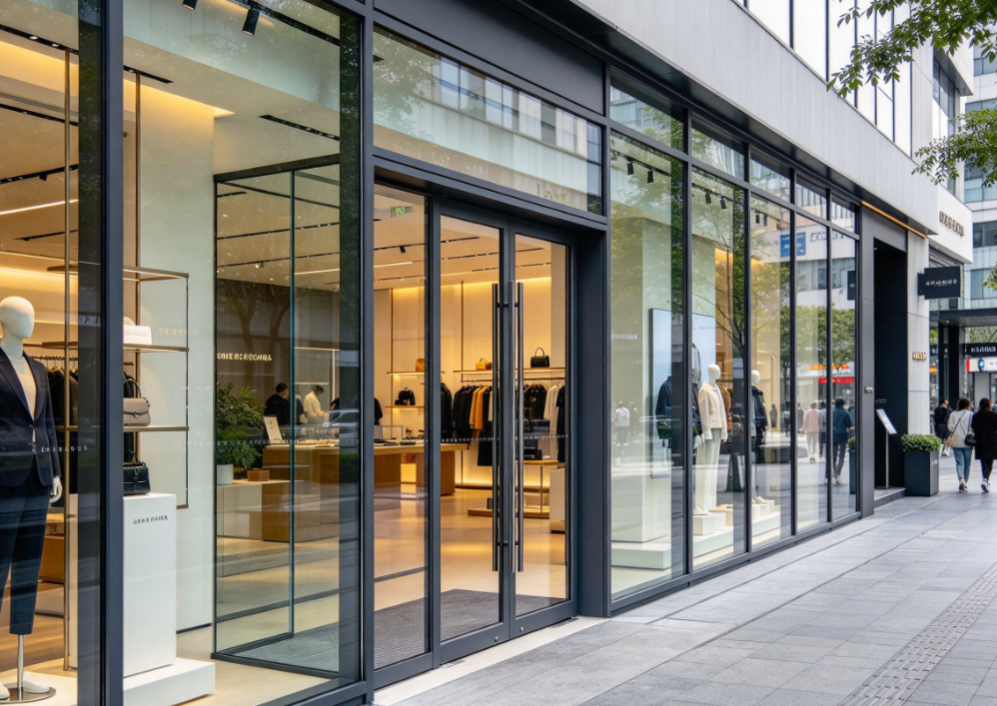
The Storefront Business Case: Visibility, Security, and the Cost of Failure
Storefront glass isn't just about safety. It's about business.
For a retail client, the storefront is the first impression. It needs to be clear, clean, and inviting. Low-iron glass—sometimes called ultra-clear or starphire—offers 91%+ light transmission compared to 88% for standard clear glass. The difference is most visible on thick glass and at the edges, which matters for high-end retail, galleries, and showrooms where true color rendering is essential.
But clarity is only half the story. Security matters too. Laminated glass—two or more plies bonded with a PVB or ionoplast interlayer—provides forced-entry resistance and keeps fragments in place when broken. It's the go-to choice for retail in high-traffic areas, restaurants, bars, and pharmacies.
For many storefronts, the solution is a combination: tempered glass for the safety glazing requirement and laminated glass for security and sound attenuation. Insulated glass units (IGUs) add thermal performance—required by energy codes for most new commercial storefront installations in the U.S.
We've seen storefront glass fail for the wrong reasons. A restaurant in a coastal city specified standard annealed glass for its storefront because the budget was tight and the glass looked fine on the drawings. Six months later, a tropical storm blew through. The glass shattered. The restaurant was closed for three weeks during the busiest season. The insurance covered the glass. It didn't cover the lost revenue.
That's the lesson. Tempered glass isn't an upsell. It's risk mitigation with a known cost.
What We've Learned From Thousands of Facade Projects
After years of exporting architectural glass, here's what we know for certain.
Tempered glass holds over 40% of the structural glazing market share because it's the only glass type that meets the combined demands of strength, safety, and thermal performance in commercial applications. The architectural flat glass market was valued at $227.63 billion in 2025 and is projected to reach $318.42 billion by 2034. The demand is there. The standards are clear. The technology is mature.
What separates a smooth facade project from a problematic one isn't the glass specification on paper. It's whether the supplier actually delivers glass that meets that specification. Whether the edgework is correct. Whether the holes are positioned within tolerance. Whether the surface compression is consistent across the batch.
We've seen containers rejected at Port of Melbourne because the glass passed Chinese standards but failed AS/NZS 2208. We've seen storefront panels fail impact testing because the tempering wasn't uniform. We've seen facade contractors lose weeks of schedule because a supplier shipped annealed glass instead of tempered—and nobody caught it until the glass was on site.
Those problems don't happen when you work with a manufacturer who understands what's at stake. They happen when you treat glass like a commodity.
Your Facade Deserves More Than a Commodity Supplier
Every facade project is a bet on the supply chain. You're betting that the glass arrives on time, meets the spec, passes inspection, and performs for decades. We've been manufacturing architectural tempered glass for projects across North America, Europe, Australia, and Asia. We know what it takes to get your glass through customs, past the inspector, and onto the building without surprises.
Whether you're specifying tempered glass for a high-rise curtain wall, a commercial storefront, or a structural glazing system, we can help you get the specification right—and deliver glass that meets it.
Send us your project details. What's the building type? What wind loads are you designing for? What standards does your market require? Let's talk about how tempered glass can make your facade safer, stronger, and more reliable.
Frequently Asked Questions
Q: How strong is tempered glass compared to annealed glass for facade applications?
A: Fully tempered glass has a characteristic bending strength of approximately 120 MPa, compared to 45 MPa for annealed glass—roughly 4 to 5 times stronger. Heat-strengthened glass sits in between at around 70 MPa. For facade applications, this strength difference is critical because wind loads on high-rise buildings can generate design pressures of 4.5 kPa to 7.0 kPa or more. Annealed glass would need to be significantly thicker to carry the same load—and even then, it wouldn't be safety glass. KINGSTAR BUILDING GLASS manufactures tempered glass to ASTM C1048, EN 12150, and AS/NZS 2208 standards, with test reports from accredited labs available for every batch.
Q: What are the code requirements for tempered glass in commercial storefronts?
A: The International Building Code (IBC) Chapter 24 requires safety glazing in hazardous locations, including glazing within 18 inches of the floor in accessible areas and glazing within 24 inches of a door edge. The Florida Building Code is more explicit—all storefronts must use tempered or safety glass for glazing below door head height. Additionally, the 2018 IBC requires impact-resistant glazing in wind-borne debris regions, tested to ASTM E1996. Tempered glass must meet CPSC 16 CFR 1201 and ANSI Z97.1 for safety glazing compliance. If your project is in a hurricane-prone area, you'll also need impact-rated assemblies—we can discuss the options with your project team.
Q: Can tempered glass handle the thermal stress on a high-rise facade?
A: Yes—and this is one of the reasons tempered glass is the default choice for curtain walls. Tempered glass can withstand temperature differentials of up to 200°C without breaking, compared to roughly 40°C for annealed glass. On a high-rise facade, one side of a panel may be in direct sun while the other is shaded, creating a temperature gradient across the glass. Annealed glass would crack under those conditions. Tempered glass handles them without issue. It can also resist temperatures up to 250°C, making it suitable for applications where thermal stress is a concern. KINGSTAR BUILDING GLASS tests every production batch for surface compression and thermal shock resistance—ask us for the test data on your next project.
References:
https://www.giiresearch.com/report/ires2095033-glass-facade-market-global-forecast.html
https://www.researchandmarkets.com/reports/5751697
https://www.marketresearch.com/OG-Analysis-v3922/Glass-Fa%c3%a7ade-Outlook-Share-Growth-42764581/
https://www.marketreportsworld.com/market-reports/structural-glazing-market-14714867
https://0-www-mdpi-com.brum.beds.ac.uk/1996-1944/14/8/1896
https://www.tandfonline.com/doi/pdf/10.1080/13467581.2026.2672249
https://expertglassrepair.com/guides/commercial-storefront-guide/
https://www.iccsafe.org
https://www.riotglass.com/astm-e1996/
https://www.marketresearch.com/OG-Analysis-v3922/Glass-Fa%c3%a7ade-Outlook-Share-Growth-42764581/
https://straitsresearch.com/report/architectural-flat-glass-market
https://www.marketresearch.com/Glass-Curtain-Wall-Market-Share-Analysis-42783681/

点击右上角
分享给朋友吧







 Long by picture save/share
0
文章推荐

Kingstar Building glass: www.kingstar-glass.com
Kinstar Glassware (Professional Glassware & Kitchen Storage): www.kingstarliving.com


Kingstar Building glass:
Email: eric@kingstar-glass.com
Kingstar Glassware
(Professional Glassware & Kitchen Storage):
Email: info@kingstar-glass.com
Address: NO.101 SHENZHEN ROAD, QINGDAO, CHINA
© 2022 Qingdao Kingstar Glass Co., Ltd . All rights reserved Site Map | Technical Support:weidongli
Building glass:
Wechat/Whatsapp: 008618562697682
Email: eric@kingstar-glass.com
Glassware please visit: www.kingstarliving.com
Wechat/Whatsapp: 008615063091883
Email: info@kingstar-glass.com
Address: NO.101 SHENZHEN ROAD, QINGDAO, CHINA

© 2022 Qingdao Kingstar Glass Co., Ltd . All rights reserved Site Map
